Wood Fillers in Hardwood Flooring: Uses and Limitations

Watch a few hardwood floor repair videos on TikTok or Instagram, and you'll find some impressive results. Holes disappear, cracks are filled, colors match perfectly, and the floor looks as though nothing ever happened.
Many of those repairs are legitimate, and some require considerable skill. But the videos rarely explain why a particular filler was selected, what condition the floor was in, or whether the repair will last.
That information is considerably more useful than watching someone spread filler with a putty knife.
Wood fillers are common in hardwood flooring. They're used during installation, sanding, finishing, and repairs. Nail holes, minor cracks, damaged edges, and other imperfections may all require some filling. The products and methods vary according to the work being performed.
Some fillers are supplied ready to use. Others are mixed with sanding dust or prepared to match a particular wood color. Manufacturers such as Woodwise, Bona, PALLMANN, LOBA, and Berger-Seidle offer products with different applications and properties.
Selecting the correct one requires more thought than simply matching the name of the wood species on the container.
Color Matching Is Difficult

White oak isn't one uniform color. Neither is maple, walnut, or any other wood species. Even boards cut from the same tree can have noticeable differences in color and grain.
A filler labeled White Oak may look acceptable in one board and stand out badly in the next.
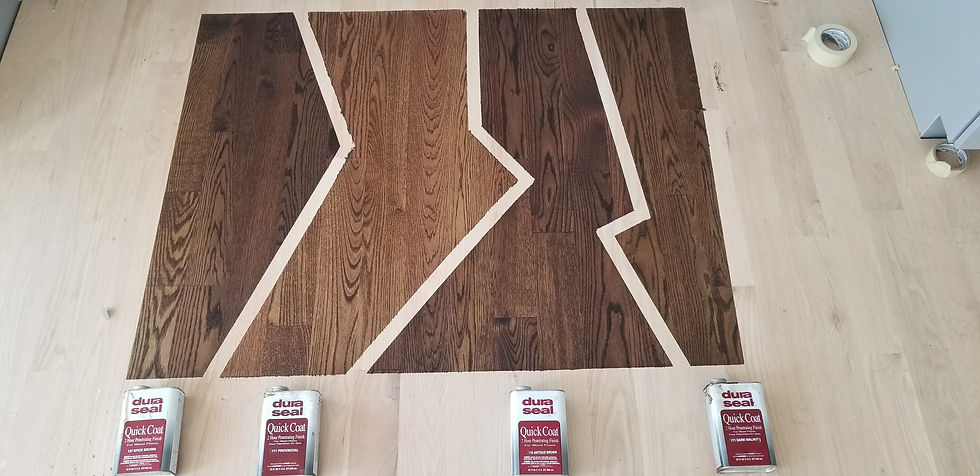
Staining adds another complication. Wood absorbs stain according to its characteristics and preparation. Fillers contain different materials and don't necessarily absorb color the same way. Some hardly absorb it at all.
A repair may look excellent before staining and become quite noticeable afterward. Even when the filler is close in color, the absence of natural grain can give it away.
Matching an existing finished floor brings its own challenges. The original color may have changed with age, light exposure, and use.
During walkthroughs and consultations, I've encountered poorly matched fillers, repairs that weren't packed properly, and materials that left discoloration along the edges of adjoining boards. In some cases, oils or solvents in the repair material contributed to the problem.
Those aren't all the same failure, and replacing the filler won't necessarily correct the damage already done.
Filling Gaps Requires More Caution
Wood expands and contracts with changes in moisture. This affects the boards and, naturally, anything placed between them.
Consider a gap that opens during winter when indoor humidity drops. As humidity increases, the boards may expand and the gap may narrow.
What happens to the filler?
Depending on its composition, the size of the opening, and the amount of movement, the material may crack, separate, or be pushed out. The finish spanning the joint may crack as well, regardless of how flexible the filler claims to be.
I've yet to find a filler that reliably solves every problem caused by seasonal wood movement.
Before filling gaps, we need to understand why they're there. Indoor humidity, flooring construction, installation conditions, and the history of the floor all deserve attention.
Small, stable gaps may be suitable for filling. Larger openings or those that change considerably throughout the year require a different assessment. Even a gap narrower than 1/8 inch isn't automatically a good candidate.
Sometimes maintaining appropriate indoor humidity is more useful than filling the opening. Other times, replacing a damaged board is the more sensible repair.
When Is Filling Appropriate?

Minor nail holes and small surface imperfections are generally straightforward applications, provided the selected product is compatible with the floor and finish.
Larger cavities require more attention. Some fillers shrink as they dry, and deeper repairs may require additional applications. Insufficient packing can leave depressions or weak spots that become noticeable later.
The condition of the surrounding wood also matters. Filling a crack in a damaged or unstable board won't repair the board itself.
A good repair should still look acceptable after normal use and changes in indoor conditions, not just immediately after sanding and finishing.
And that brings us back to those repair videos.
The methods shown may be perfectly suitable for the floor being repaired. The problem begins when viewers assume the same materials and techniques apply to every floor, regardless of species, finish, damage, or movement.
There's nothing wrong with a repair remaining slightly visible when that's what the materials and conditions allow. I'd rather explain that before the work than promise a perfect match and argue about it afterward.